
Refrigeration Cycle Diagram: How Does It Work?
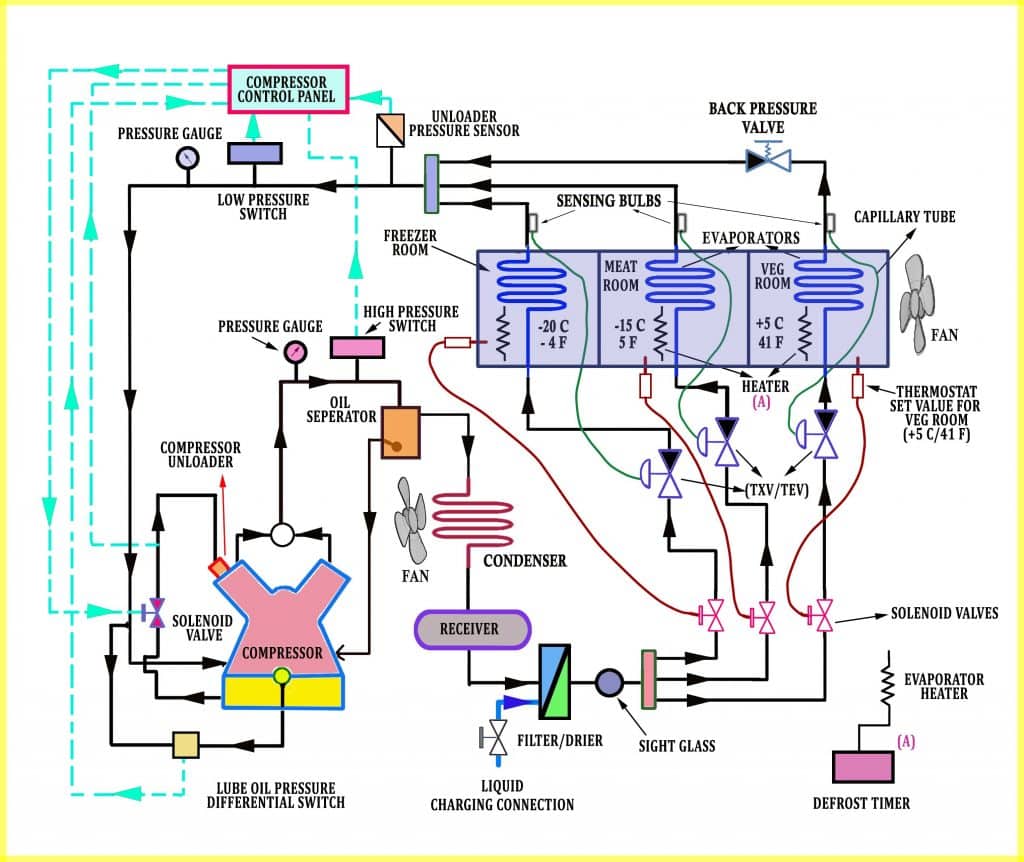
A basic refrigeration cycle diagram shows four major components: the compressor, condenser, thermostatic expansion valve (TEV), and evaporator. Together, these components transfer heat from one location to another, producing the cooling effect needed in the conditioned space. 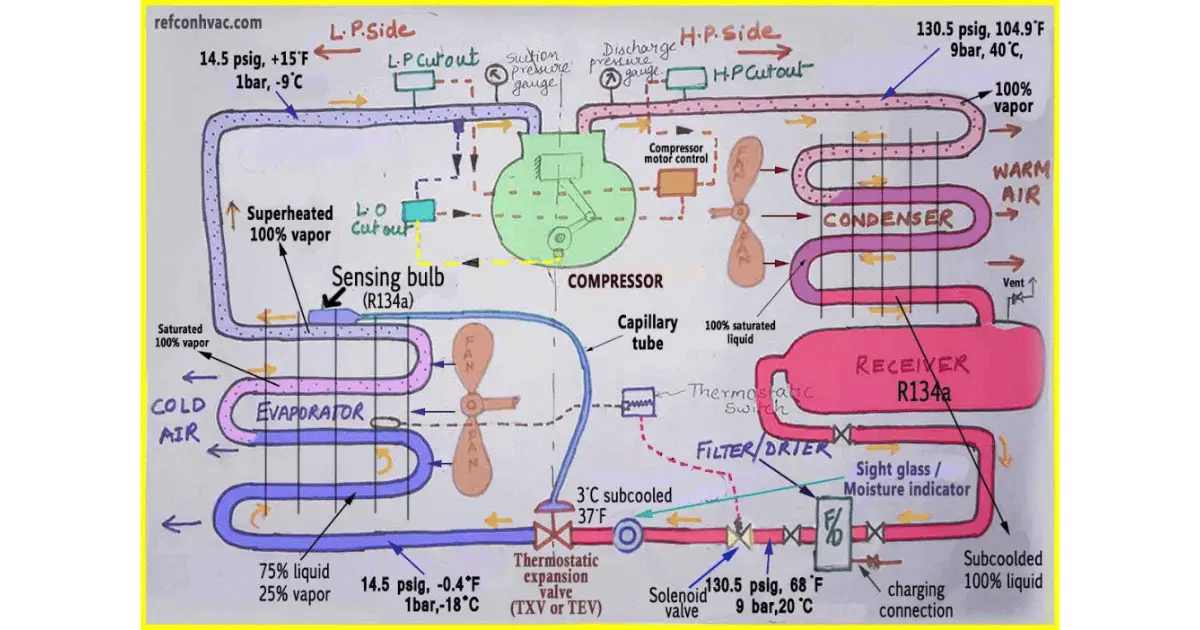
Stage 1: Compression
The refrigeration cycle begins with the compressor, which drives the refrigerant through the system and raises its pressure and temperature.
How does a Compressor work?
In the refrigeration cycle, the compressor draws in low‑pressure vapor refrigerant from the evaporator and compresses it, raising both its pressure and temperature to the level required by the condenser.
This action drives the refrigerant through the system and ensures continuous circulation. The most common compressors are positive displacement types, such as reciprocating, screw, or scroll compressors.
Consider the example of a refrigerator: as the refrigerant passes through the evaporator, it absorbs heat from the refrigerated space and changes phase from a liquid to a vapor.
To continue the cycle, the compressor then comes into action, raising the refrigerant’s pressure and temperature and converting it from a low‑pressure, low‑temperature vapor into a high‑pressure, high‑temperature vapor.
In the absence of a compressor, the heat may start to flow from the condenser to the outside air.
Hermetic Compressor (Fridge Compressor)
Hermetic compressors are commonly used in household refrigerators, both motor and compressor are enclosed in a steel housing, also known as a hermetic container, where no gas or liquid can escape past the welded seals surrounding the container.
The hermetic compressor has a direct drive with no coupling and no mechanical seal.
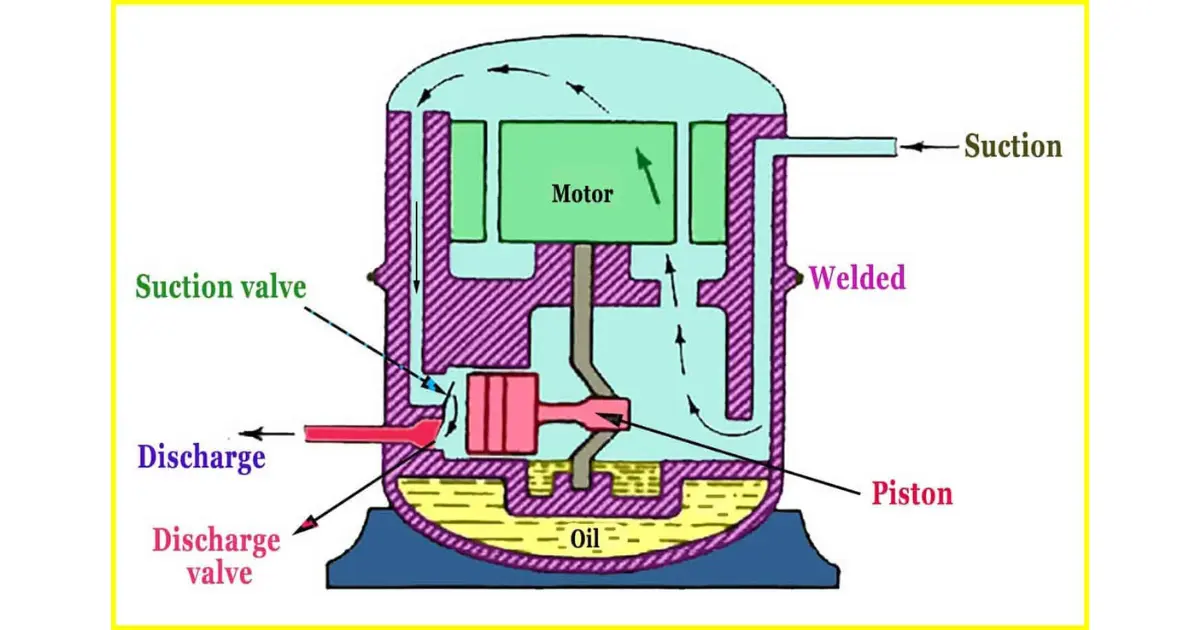
The hermetic compressor has a low-pressure housing, which means that the interior of the compressor housing is subjected only to suction pressure whereas discharge can cause stress hazard inside the compressor.
The refrigerant and compressor oil inside the compressor housing is totally in contact with the motor rotor and stator windings. So, to avoid any short circuit within the motor winding the refrigerant used must have a high dielectric strength and must be fully compatible with the insulation material.
The electric motor connects directly to the compressor via a single shaft, eliminating the need for a coupling or mechanical seal and leaving no chance of refrigerant leaking into the atmosphere.
The crankshaft is designed to circulate lubricating oil from the pump to all bearing surfaces.
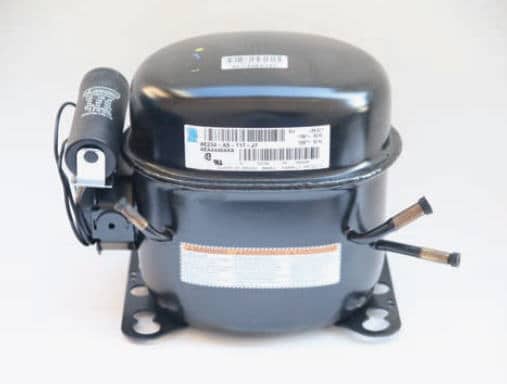
A typical household hermetic compressor may be used continuously for more than 20 years, but often at the end of its service period, it is moved to secondary duty like it can be used as a refrigerant evacuation pump after some modification, traded and resold, or discarded.
Since the motor, as well as the compressor, is not accessible for repair or maintenance, a failure of the inbuilt motor winding like short circuit can cause the decomposition of the refrigerant and serious contamination of the crankcase lubricating oil.
Therefore to avoid such damage, internal and external motor protection devices shuts off the motor power supply in case of any fault.
Commercial Refrigeration Compressor
The Commercial Refrigeration Compressor is usually a reciprocating or a screw compressor. It provides the differential pressure and a necessary flow around the system by raising the refrigerant temperature and pressure thereby giving a desired mass flow rate.
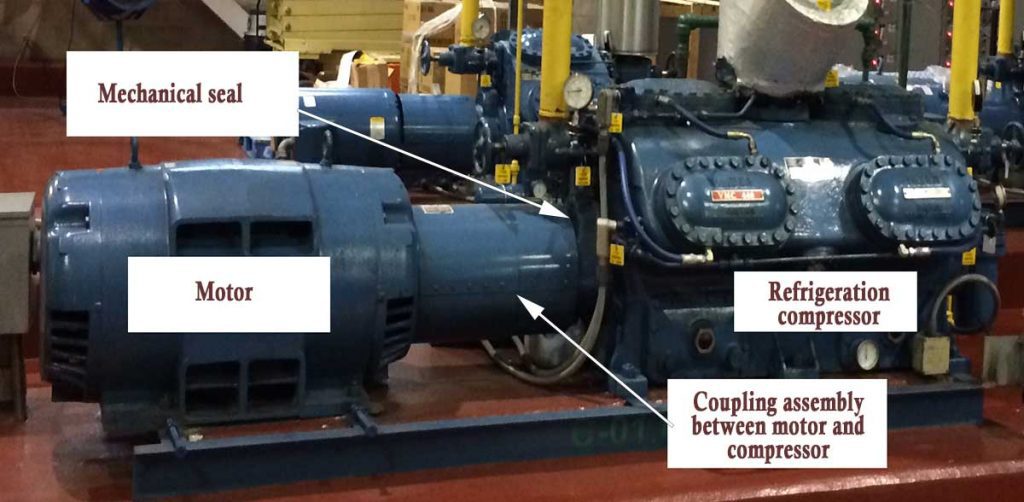
The purpose of the compressor in the refrigeration cycle is to accept the low-pressure dry gas from the evaporator and raise its pressure to that of the condenser.
The rate of heat absorption by the evaporator differs from different cargoes carried and the outside air temperature.
Sometimes cargo/stores are freshly located in a warm climate, the cooling load on the system increases significantly.
Therefore, most large compressors are multi-unit v –type compressor fitted with some arrangement of load or capacity control.
The load controller senses the temperature and controls the capacity of the compressor by off-loading or cutting out one of the compressor unit.
For the reciprocating units, this is carried out by using unloader push pins to keep the suction valve lifted from their seats.
Question: Why is a coupling needed in a commercial refrigeration compressor and motor?
Couplings are used to connect large compressor shaft with the compressor motor shaft, a driving force in these large units are very high.
- The coupling can allow some amount of flexibility during miss alignment of shafts.
- It can save the compressor when there is a sudden excess torque by allowing limited slip or twist.
Question: What is the function of a Mechanical Seal in a refrigeration compressor?
The mechanical seal screwed on the rotating compressor shaft provides sealing of crankcase, also contains the crankcase pressure and prevents any contamination from outside substance.
Stage 2: Condensation
After leaving the compressor as a high‑pressure, high‑temperature vapor, the refrigerant enters the condenser. Here, it releases the heat it absorbed from the evaporator into the surrounding air or water. 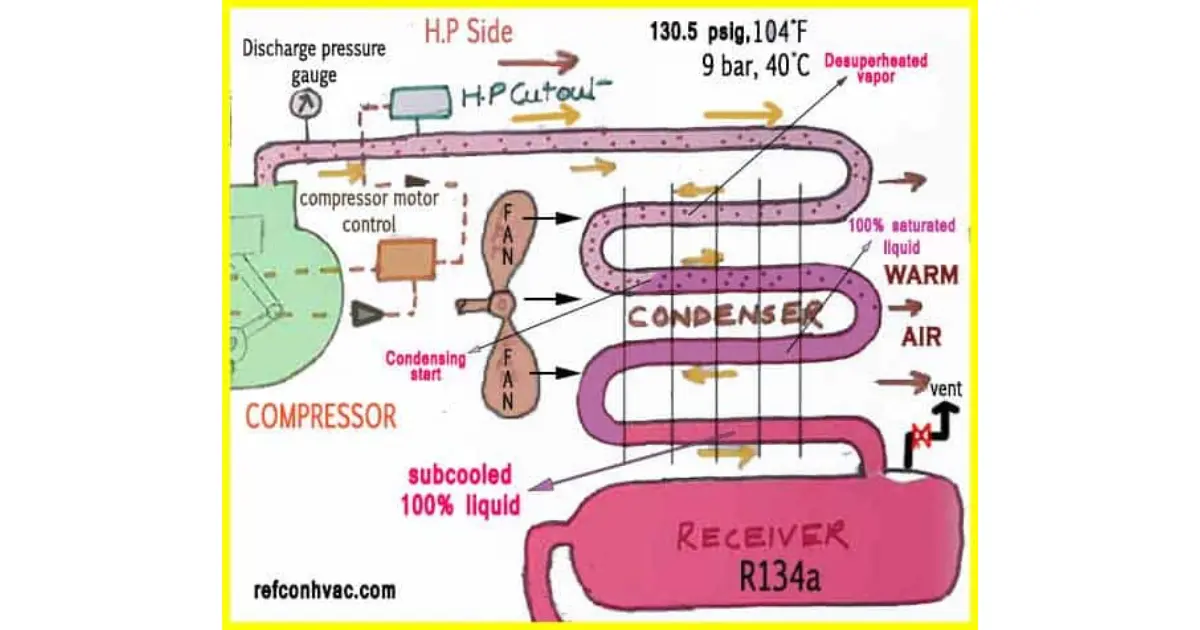 As the refrigerant loses heat, it changes phase from a vapor back into a high‑pressure liquid.
How does condensation work in hot climates?
In hotter regions the outside air can reach 42–48 °C, yet the refrigerant still condenses back to liquid because of its critical temperature.
What is the critical temperature of a refrigerant?
The critical temperature of a refrigerant is the highest temperature at which it can exist as a liquid, regardless of the pressure applied.
Above this temperature, the refrigerant cannot be liquefied by pressure alone and exists only as a gas.
This property is crucial in designing and operating refrigeration and air conditioning systems, especially in hot climates.
How does a refrigeration condenser function?
The condenser coil receives hot, high‑pressure vapor from the compressor and cools it, first removing the superheat and then rejecting the latent heat.
This process causes the refrigerant to condense back into a high‑pressure liquid, ready for the next stage of the cycle.
What is latent heat?
Latent heat is the energy required to change a substance’s state — such as from solid to liquid or liquid to gas — without altering its temperature.
For example, when ice melts into water or water boils into steam, latent heat is absorbed or released, yet the temperature of the substance remains constant during the phase change.
This concept is fundamental to understanding how materials absorb or release energy during state transitions. Condenser cooling mediums are usually fan or water
The small condensing surface required by a domestic appliance such as a fridge/freezer uses the outside metal skin of the body itself as a surface heat exchanger.
In such a construction, the condenser tubes are mechanically fixed in close contact with the skin, so that heat gets conducted through to the outside air by natural convection. 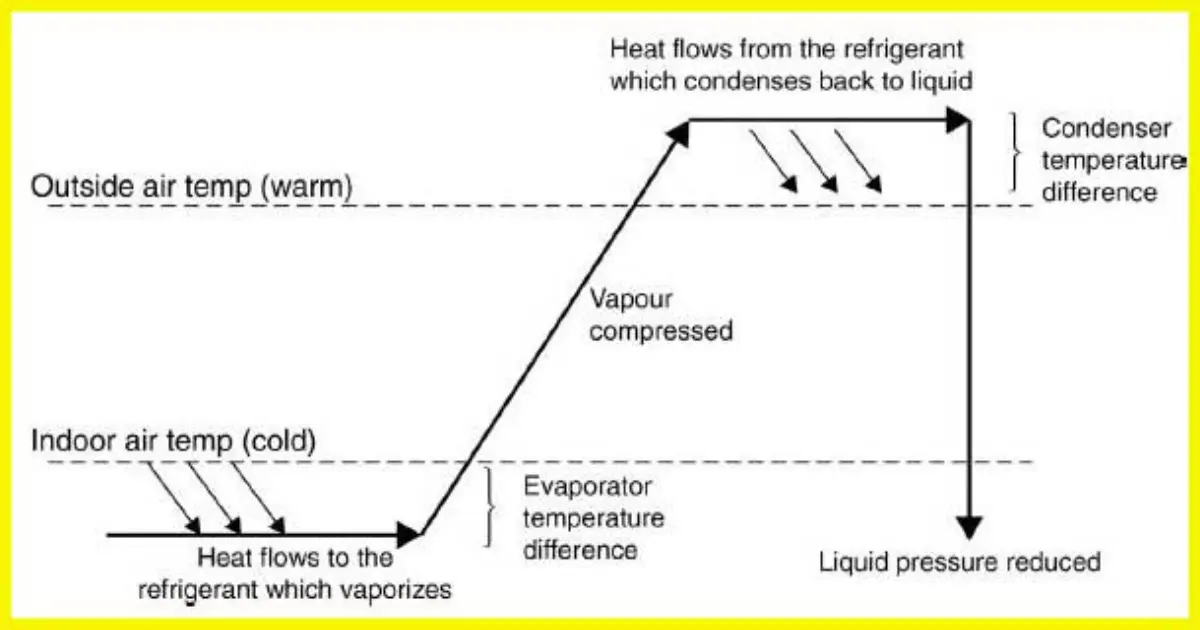 Types of condenser:
- AIR-COOLED CONDENSERS
- WATER-COOLED CONDENSERS
- EVAPORATIVE CONDENSERS
Filter Drier: Essential for Moisture Removal
The primary purpose of a filter drier is to effectively filter and capture small foreign particles, absorb any moisture or water present in the refrigeration system, and also neutralize and absorb acids that may be generated within the system.
It is typically installed in the liquid line at the outlet of the condenser coil. One of the major concerns in a refrigeration system is the presence of acids, which can cause damage and failure to various components.
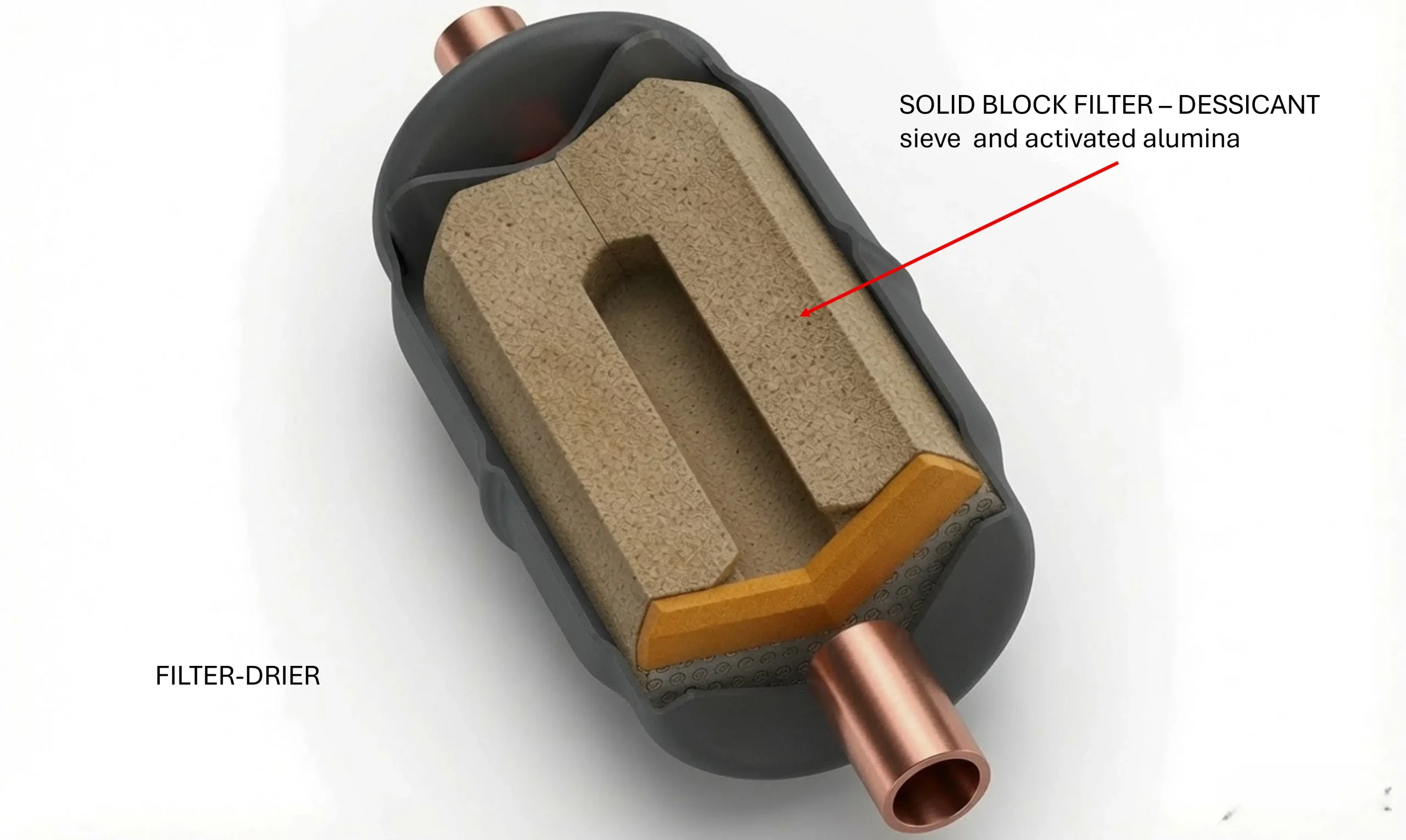
The filter drier plays a vital role in protecting the system by absorbing these acids and preventing them from causing corrosion and harmful effects on compressor valves, motor windings, and other sensitive parts.
By effectively absorbing acids, the filter drier helps maintain the integrity and efficiency of the refrigeration system, ensuring its smooth operation and prolonging its lifespan.
Exposure to moisture can have detrimental effects on lubricating oil, compromising its effectiveness and potentially resulting in the buildup of corrosive sludge.
This accumulation of sludge, which can contain metallic or acidic components, has the potential to block or obstruct valves and other vital oil passages, impeding their proper functioning.
Moisture present in the air conditioning system reacts with the refrigerant, resulting in the formation of an acidic solution.
This solution can corrode copper tubings and extract copper from copper-based alloys found in various components of the system, such as brass or bronze.
The copper extracted from these materials can accumulate in the compressor bearings and valves, creating a “copper plating” effect.
This buildup of copper can cause issues such as system leaks, improper evacuation or vacuuming, malfunction of the filter/drier, and contamination of the oil and refrigerant.
To combat this problem, desiccants are used in filter driers to absorb moisture. Common solid desiccant materials include silica gel, activated alumina, zeolites, titanium dioxide, activated carbons, metal oxides, and specially developed porous metal hydrides.
Silica gel is particularly effective and widely used due to its long-term stability, although it is only suitable for low-temperature systems
Sight glass|Moisture indicator of refrigeration system
Sight glass gives a more accurate reading in a horizontal position and shows up bubbles on the top of the sight glass/moisture indicator.
In the vertical position, the refrigerant gas bubbles go anywhere in the sight glass/moisture indicator.
The presence of bubbles in sight glass during normal operation indicates low refrigerant.
Sight glasses are used to indicate whether refrigerant vapours are present in the pipe, which should carry only liquid refrigerant.
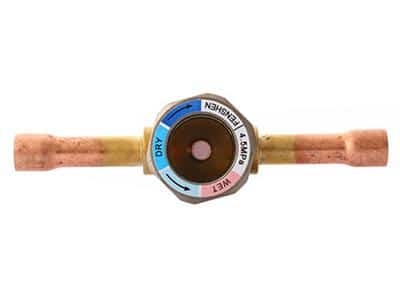
The sight glass is installed closest to the thermostatic expansion valve so as to determine how much liquid is present at the expansion valve and being drawn from the filter drier; it can also be used to indicate the moisture content present in the refrigerant.
An indication of only liquid means the system is correctly working, while the presence of any gas bubbles means the system is getting short of refrigerant.
Moisture-indicating sight glasses have a colour indicator that changes colour when the moisture content of the refrigerant exceeds the critical value.
Commonly used materials for sight glass are brass metals and for ammonia, it’s steel or cast iron.
Stage 3: Expansion (TEV)
This stage is where the pressure of the refrigerant is suddenly reduced, causing its temperature to drop as well. The expansion process prepares the refrigerant for the evaporator by creating the low‑pressure, low‑temperature conditions needed for effective heat absorption.
What is a thermostatic expansion valve (TXV or TEV) or Metering valve: Throttling device?
A thermostatic expansion valve (TEV), also known as a metering device, is an essential component in a refrigeration or air conditioning system.
Its primary role is to regulate the flow of refrigerant into the evaporator coil. By maintaining a certain degree of superheat, the TEV ensures that liquid refrigerant does not enter the suction side of the compressor.
Also, it maximizes heat exchange between the evaporator coil and the refrigerated area. The valve controls refrigerant flow so that the refrigerant leaving the evaporator is a slightly superheated vapor.
This guarantees that the full latent heat has been absorbed, which improves system efficiency and reduces the mass flow rate required.
A sensing bulb with a good thermal contact is fastened at the evaporator outlet to make sure the refrigerant gas leaving the evaporator outlet is superheated.
As the bulb temperature rises, the refrigerant inside it expands, opening the expansion valve and allowing more refrigerant to flow through the evaporator
When the flow becomes excessive, the outlet temperature falls, reducing the bulb pressure and causing the valve to close.
This self‑regulating action maintains stable operation. In smaller refrigeration and air conditioning systems, a capillary tube is often used instead of a thermostatic expansion valve (TEV).
Another phenomenon takes place across the Thermostatic expansion valve(TEV), ie. the flashing effect. When the refrigerant passes through the valve, the sudden pressure drop lowers its temperature.
Heat is extracted from the remaining liquid, causing part of it to evaporate or “flash” into vapor.
This process is known as flashing. The expansion valve is designed to handle liquid only, a vapor‑liquid mixture can cause malfunction.
To avoid this, sufficient subcooling must be provided in the condenser so that only liquid refrigerant reaches the valve.
The thermostatic expansion valve (TEV) plays a vital role in controlling and metering the flow of liquid in the system.
Why must the sensing bulb use the same refrigerant as the system?
The sensing bulb is filled with the same refrigerant as the system (e.g., R134a) for two key reasons:- To ensure the bulb expands and contracts in the same way as the system refrigerant, providing accurate valve control.
- If the diaphragm ruptures, that bulb refrigerant can leak into the main refrigeration system.
How does a thermostatic expansion valve (TEV) work?
- Bulb pressure on one side of the diaphragm tends to open the valve.
- Evaporator pressure on the opposite side of the diaphragm tends to close the valve.
- Spring pressure applied to the pin carrier gets transmitted through the pushrods to the evaporator side of the diaphragm. This assists in closing the valve.
Why an Equalizing Line is Required in a Thermostatic Expansion Valve (TEV)
There is always pressure drop across the evaporator in practical, and it’s even higher in large evaporators.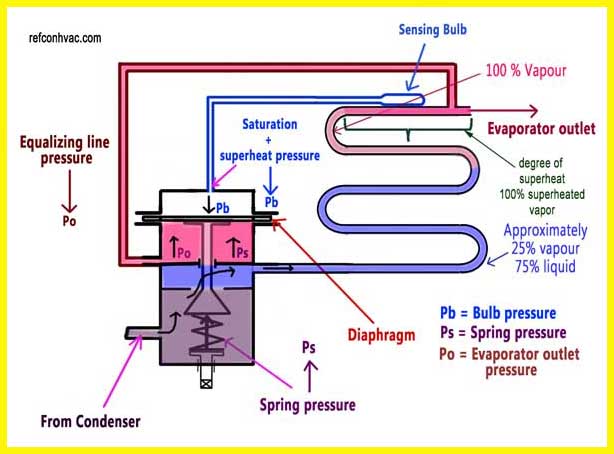
Stage 4: Evaporation
The evaporator plays a critical role in the refrigeration cycle by converting low‑pressure, low‑temperature liquid refrigerant into vapor.How the Evaporator Absorbs Heat?
The refrigerant absorbs heat from the surrounding environment inside the refrigerated space.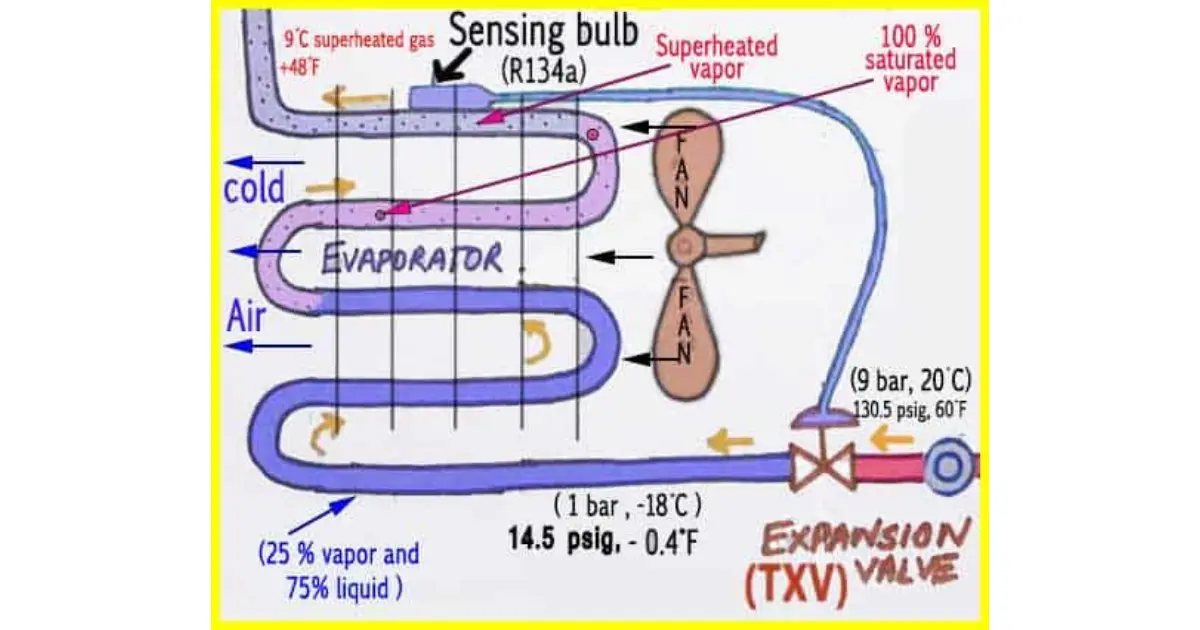
How does the evaporator maximize heat absorption?
The evaporator is strategically located within the space that requires cooling and operates at a temperature lower than its surroundings.- Air‑cooling evaporators
- Liquid‑cooling evaporators
Key Questions and Answers in Refrigeration:
Why must the critical temperature of a refrigerant be high?
The critical temperature of a refrigerant is the maximum temperature above which it cannot be liquefied, regardless of the pressure applied.What is Heat?
Heat is a form of energy present in all objects on Earth, expressed in terms of both quantity and intensity.- Heat energy cannot be destroyed; it can only be transferred.
- Heat always flows from a higher‑temperature substance to a lower‑temperature substance.
- Heat transfer occurs through one of three processes: conduction, convection, or radiation.
What is a ton of refrigeration?
A ton of refrigeration is a unit of cooling capacity. It is defined as the amount of heat required to melt one ton (2,000 lb or 907.18 kg) of ice in 24 hours.What is subcooling?
Subcooling is the process of cooling a refrigerant below its condensing (saturation) temperature so that it becomes a 100% liquid. Any additional cooling of the liquid refrigerant beyond this point is referred to as subcooling.What are the advantages of subcooling?
Subcooling provides several important benefits in a refrigeration system:- Reduces flash gas formation – By cooling the refrigerant below its condensing temperature, subcooling minimizes vapor formation at the expansion valve, ensuring only liquid enters the evaporator.
- Increases evaporator capacity – Subcooled liquid has a lower specific volume, allowing more refrigerant mass to flow through the evaporator, which boosts cooling capacity.
- Improves efficiency – With more liquid refrigerant available for heat absorption, the evaporator extracts more heat from the conditioned space, enhancing overall system performance.
What is superheating?
Superheating is the process of adding heat to a refrigerant vapor after it has completely evaporated inside the evaporator coil.Cycle Controls & Safety Devices
Solenoid Valve in refrigeration system
The solenoid valve is an electromagnetic valve for the automatic opening and closing of liquid and gas lines.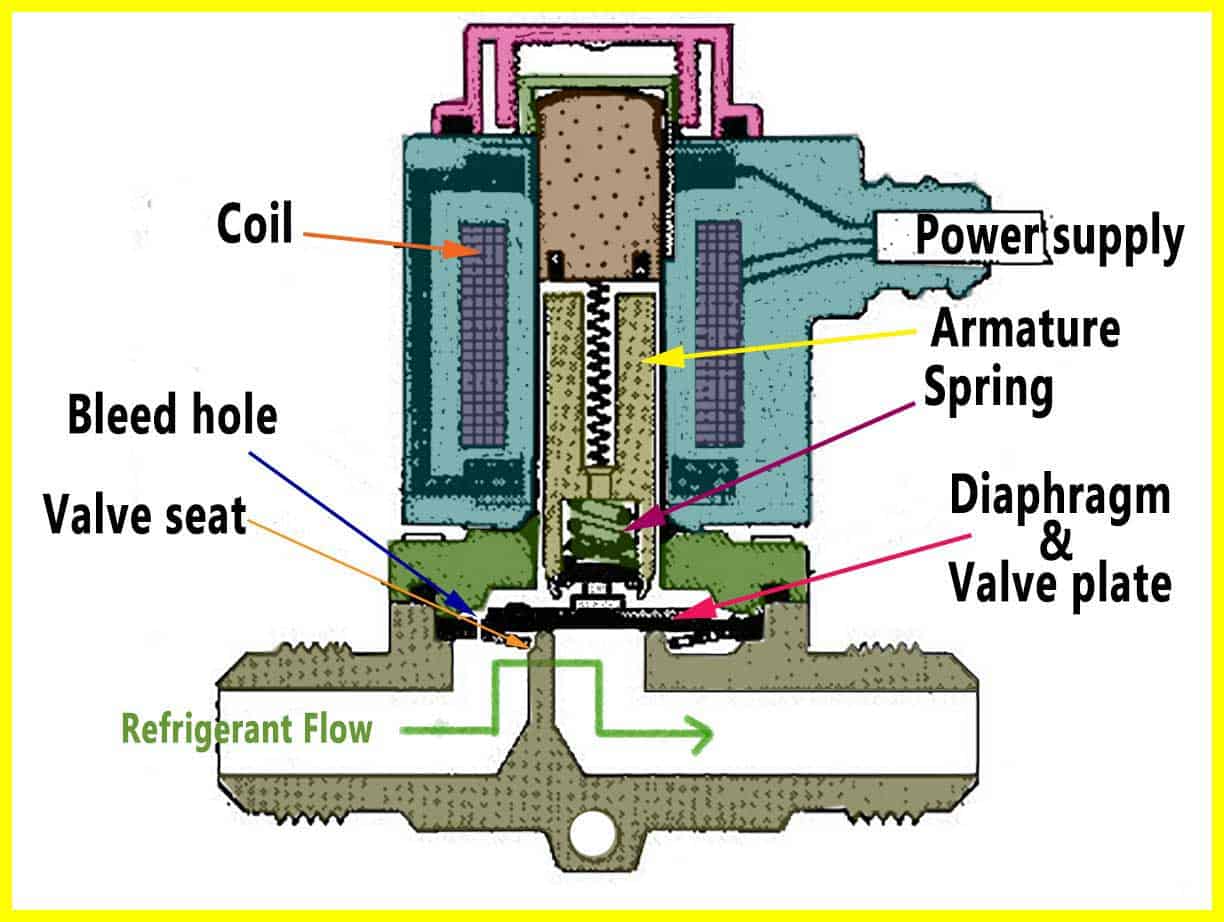
Back Pressure Valve in Refrigeration System
A back pressure valve may sometimes be fitted into the system to hold back a high evaporator pressure, where two to three evaporator outlet feeds into a common compressor suction line.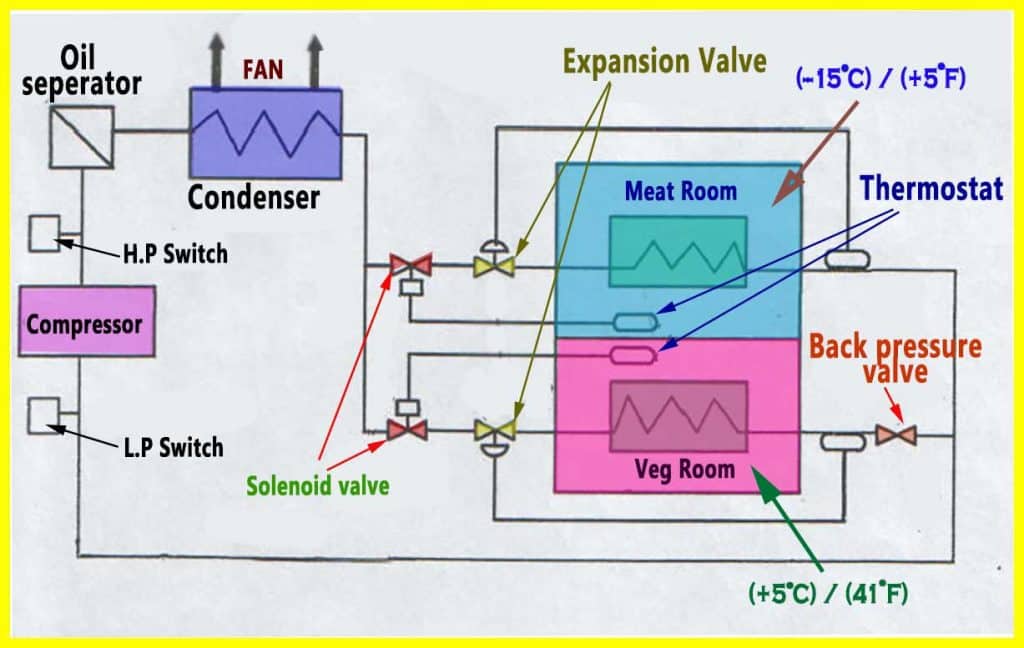
Safety Devices in refrigeration system:
Refrigeration Compressor Unloader Safety device
Large refrigeration compressors typically operate with 2 to 3 cylinders configured in a V or W-type arrangement, provided with an unloading mechanism.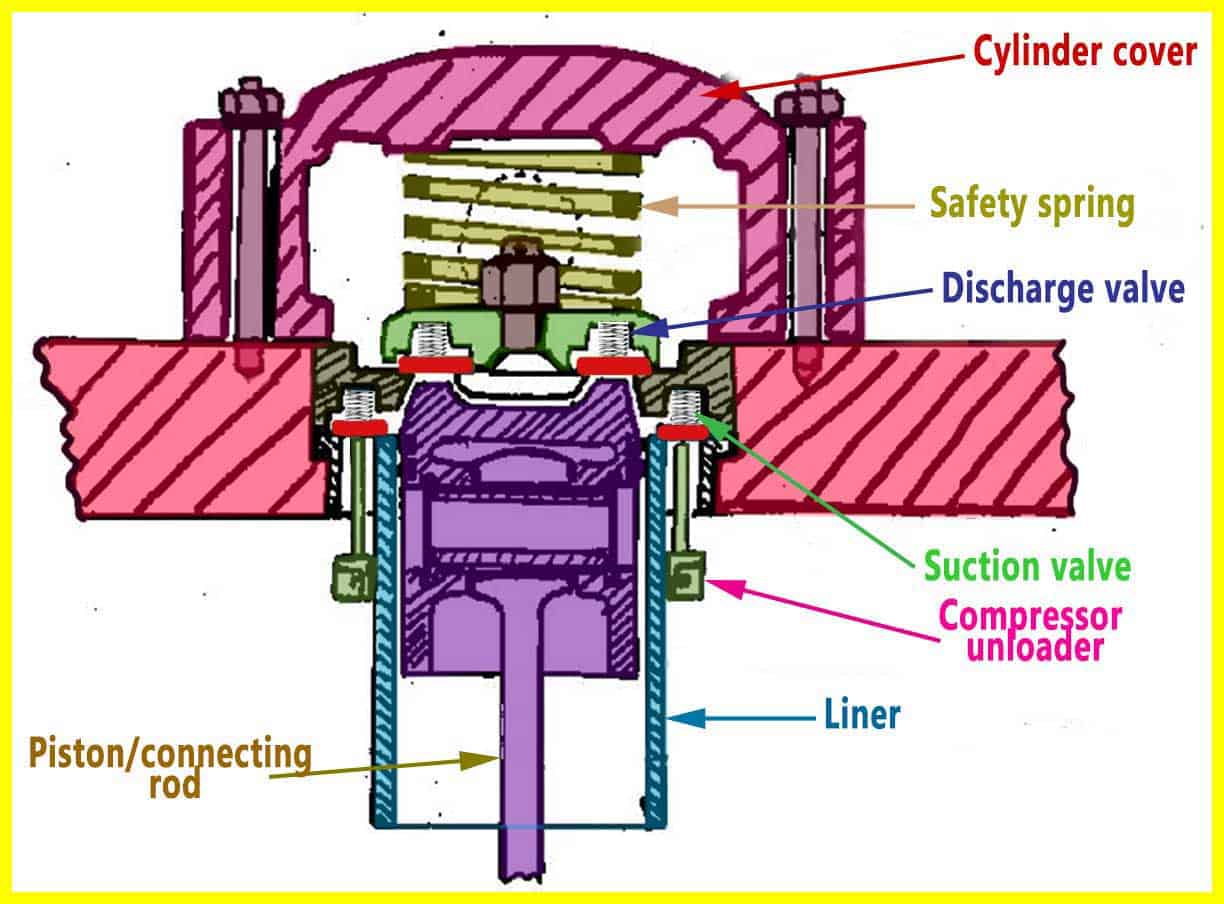
Compressor High Pressure cut out Safety Device
The compressor is fitted with a discharge high-pressure trip safety device, which prevents over-pressurization of the system and overload of the compressor motor.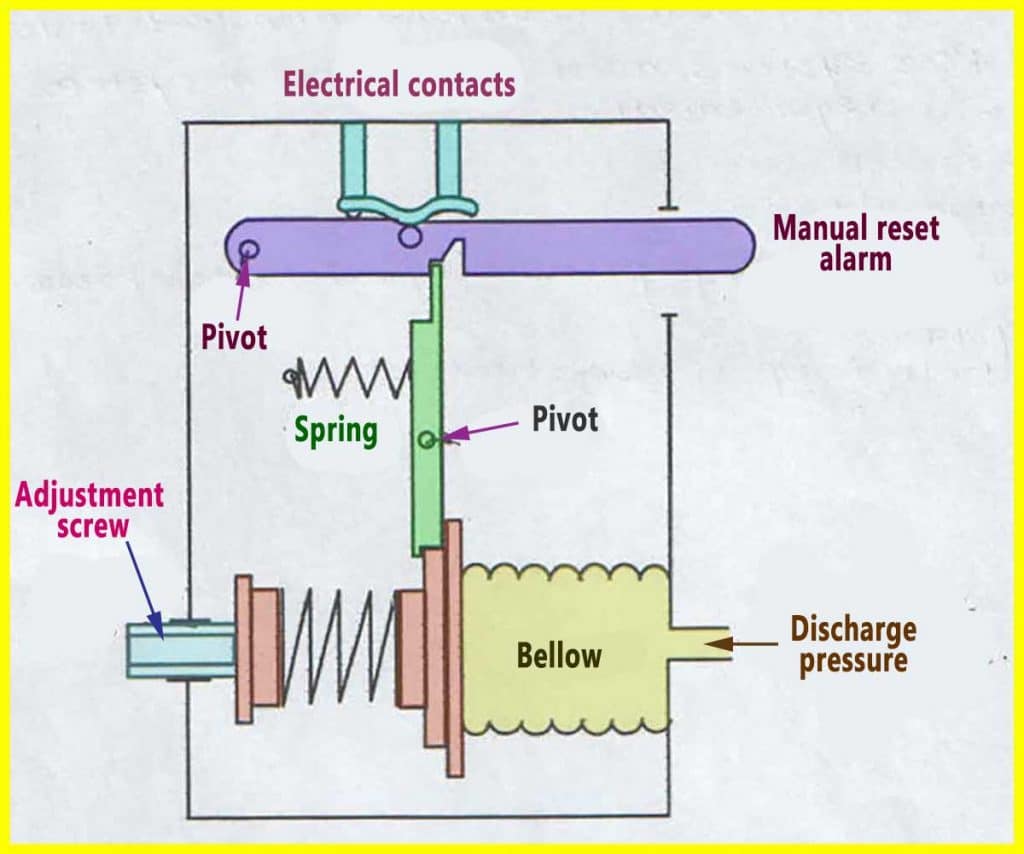
Compressor Low Pressure cut out Safety Device
Low-pressure cutout switch safety device is used to protect against too low suction pressure, which usually indicates a blockage by dirt, ice formation if water is present in the system or loss of refrigerant.Compressor Differential Lube Oil Pressure Safety Device
Differential lube oil pressure switch safety device is used to protect against too low oil pressure in forced lubrication systems.How to Oil separator remove oil from the Refrigeration System?
Some oil always gets carried over with the compressed refrigerant gas and must be removed. Oil Separator function:- To prevent oil from entering and fouling the internal surfaces of the evaporator and other heat exchangers its important that the oil return in refrigeration compressor.
- To ensure oil gets a return to the compressor crankcase, preventing any failure of moving mechanical parts from any shortage of oil.
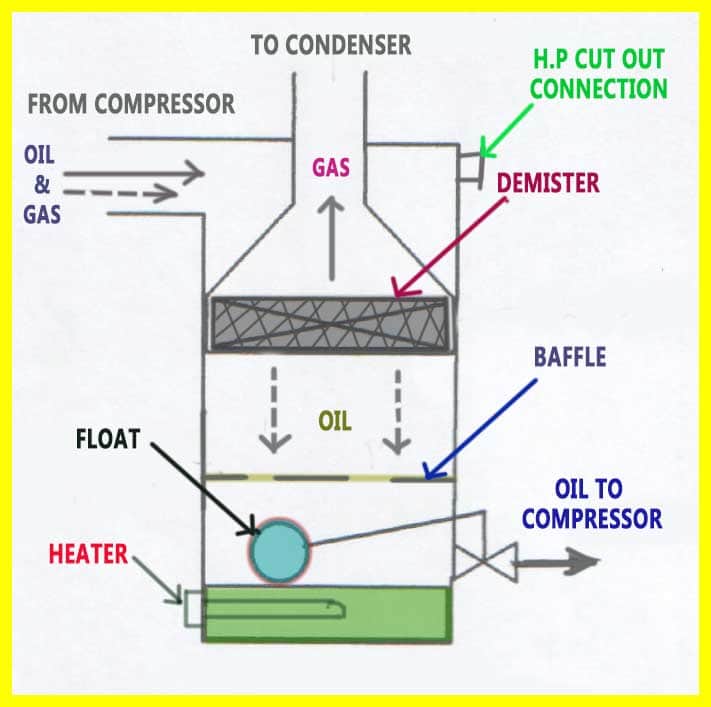
Why does a refrigeration compressor take suction from its crankcase?
The outlet of the evaporator coil leads into to the compressor crankcase, and the advantages of this design are:- Since the crankcase is pressurized, no air can enter into the system.
- Helps in the lubrication of compressor piston, liner, and other moving metal parts.
- Refrigerant gas is miscible with oil; this property helps the gas to bring the oil back into the system via the Oil Separator.
Thermostats
Thermostats are temperature-controlled electric switches, used for both safety and control functions.- A fluid-filled bulb connected through a capillary to a bellows.
- A thermistor.
- A bi-metal element.
Pressure Relief Safety Device
Refrigeration systems are designed to withstand a maximum working pressure (MWP) which, if exceeded as a result of a fire, extreme temperature conditions, or faulty electrical controls, may cause some part of the system to explode.There are three types of relief devices
- Spring-loaded relief valves remain set to open at the MWP and close when the pressure drops to a safe level. Relief valves must not be interfered while in service and must be locked or sealed to prevent unauthorized adjustment.
- Bursting discs, which comprise thin metal diaphragms designed to burst at a pressure equal to the MWP.
- Fusible plugs, which contain a metal alloy, melts when the temperature in the system corresponding to the MWP.
Refrigeration system: Hot gas Bypass valve
Hot gas bypass valves used in compressors do not have a capacity reduction device like a compressor unloader.Refrigeration cycle P-H diagram
A Pressure–Enthalpy (P‑H) diagram, also called a Mollier diagram, is a graphical tool used to represent the thermodynamic properties of a refrigerant. It is widely used in analyzing and designing refrigeration cycles. The diagram clearly shows the four main processes of the cycle: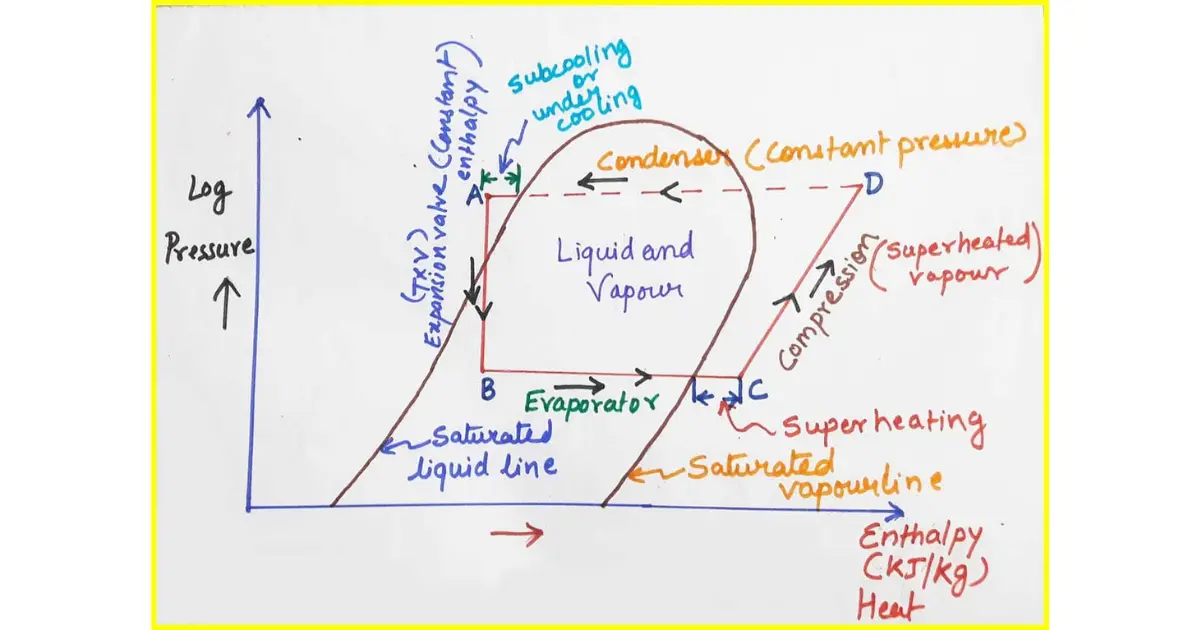
- C → D: Compression Low‑pressure vapor refrigerant enters the compressor at point C. It is compressed to a high‑pressure, high‑temperature vapor and discharged at point D.
- D → A: Condensation At constant high pressure, the refrigerant vapor rejects heat to the environment in the condenser. It condenses into a high‑pressure liquid at point A.
- A → B: Expansion (Throttling) The liquid refrigerant passes through the expansion device at constant enthalpy. The sudden pressure drop causes part of the liquid to flash into vapor (about 25% vapor, 75% liquid). This reduces the refrigerant temperature to the saturation temperature at the low‑side pressure.
- B → C: Evaporation The low‑temperature refrigerant absorbs heat from the environment inside the evaporator. It evaporates completely at constant pressure, returning as low‑pressure vapor to point C, ready to repeat the cycle.

Refrigeration cycle: HVAC system basics and refrigerant charging from r/HVAC
Put the theory on this page to work — every tool is free and gives an instant answer.
- AC Tonnage Calculator — Work out the tonnage a room or building actually needs.
- BTU Calculator — Convert BTU to tons, kW and the room size it will cover.
- Duct Size & CFM Calculator — Size the ductwork and CFM once you know the load.
- AC Repair Cost Calculator — What a failed compressor, TXV or other cycle component costs to repair.
- SEER2 Savings Calculator — See what a more efficient system would save on running costs.

well done explanation for basic refrigeration system
Pretty portion of content. I just stumbled upon your blog and in accession capital to say that I acquire actually enjoyed account your weblog posts. Anyway I will be subscribing on your augment or even I success you access persistently quickly.| а
This site has helped me with all that I have been looking for